


Blog

Who Is Responsible for Snow Removal in NYC? Property Owner, Landlord, and Tenant Duties

who is responsible for snow removal in NYC
In New York City, the adjoining property owner generally must clear snow and ice from the sidewalk, even though the City clears public streets. The answer to who is responsible for snow removal in NYC depends on where the snow has accumulated and who controls the property. Silberstein & Miklos, P.C. represents injured New Yorkers in slip-and-fall cases, and we see how quickly uncleared slush can refreeze into a hazard.
Key Takeaways
- Property owners in New York City carry the legal duty to keep sidewalks clear of snow and ice, even though the City handles the streets themselves.
- Responsibility depends on who controls the property, so landlords, tenants, and owners should confirm their duties before a storm hits.
- Slush and partial melting often refreeze into dangerous ice patches, which is why delayed removal causes so many fall injuries.
- If you were hurt in a slip-and-fall on an uncleared sidewalk, documenting the scene quickly can strengthen your claim.
- Silberstein & Miklos, P.C. offers a free consultation to help injured New Yorkers pursue maximum compensation.
For pedestrians and tenants, the practical starting point is the location of the sidewalk and the property next to it. Know which areas the City handles, what the law requires from adjoining property occupants, and when the clearing deadline applies.
Who Is Responsible for Snow Removal in NYC? The Short Answer
Usually, the owner, lessee, tenant, or occupant of property next to a sidewalk must clear snow and ice from that sidewalk under NYC Administrative Code §16-123. The City handles snow on public streets. The rule does not mean every person named has equal responsibility in every situation; property ownership, occupancy, and control matter.
Property Owners Carry the Legal Duty Under NYC Administrative Code §16-123
Section 16-123 places the sidewalk-clearing duty on the owner, lessee, tenant, or occupant of property adjoining the sidewalk. The New York City Department of Sanitation (DSNY) explains the snow-removal rules and responsibilities. The law aims to keep a pedestrian path open, rather than leave neighbors, commuters, or people using wheelchairs to pick their way through packed snow and ice.
For an injury claim, a missed shoveling duty alone does not automatically establish liability. The facts matter, including who controlled the area and whether the snow or ice created the condition that caused the fall.
What DSNY Clears vs. What You Must Clear
DSNY clears snow from the City’s 19,000 lane miles of streets, according to the agency’s snow-removal information. The Department of Transportation (DOT) also handles designated City responsibilities, such as certain pedestrian facilities. Those city operations are separate from the duty to clear a private property’s adjoining sidewalk.
So, a plowed roadway does not mean the sidewalk beside it is safe. Property occupants must address sidewalk snow and ice under the City rules. Snowplows can also push slush toward the curb, where it may freeze again and obstruct a curb ramp or walking route.
Responsibility Matrix: City, Owner, Landlord, Tenant, Board, and Commercial Occupant
This table gives a starting point for identifying the responsible party. A lease, property arrangement, or the exact location of the snow can affect the answer. When a fall occurs, document the area and property adjoining it instead of assuming the City or a landlord controlled every part.
| Person or entity | Typical snow-removal role |
|---|---|
| City / DSNY | Clears public streets and performs assigned City snow operations. |
| Property owner | Has the statutory duty for the adjoining sidewalk under §16-123. |
| Landlord | May arrange building snow removal and remains a key party to examine for control and responsibility. |
| Tenant or occupant | May have a duty under the law or an agreement, depending on occupancy and the property arrangement. |
| Co-op or condo board | May control and arrange maintenance in shared areas; governing documents and site control matter. |
| Commercial occupant | May have obligations as an occupant or under an agreement with the owner. |
Snow Removal Deadlines, Path Width, and Fines in NYC
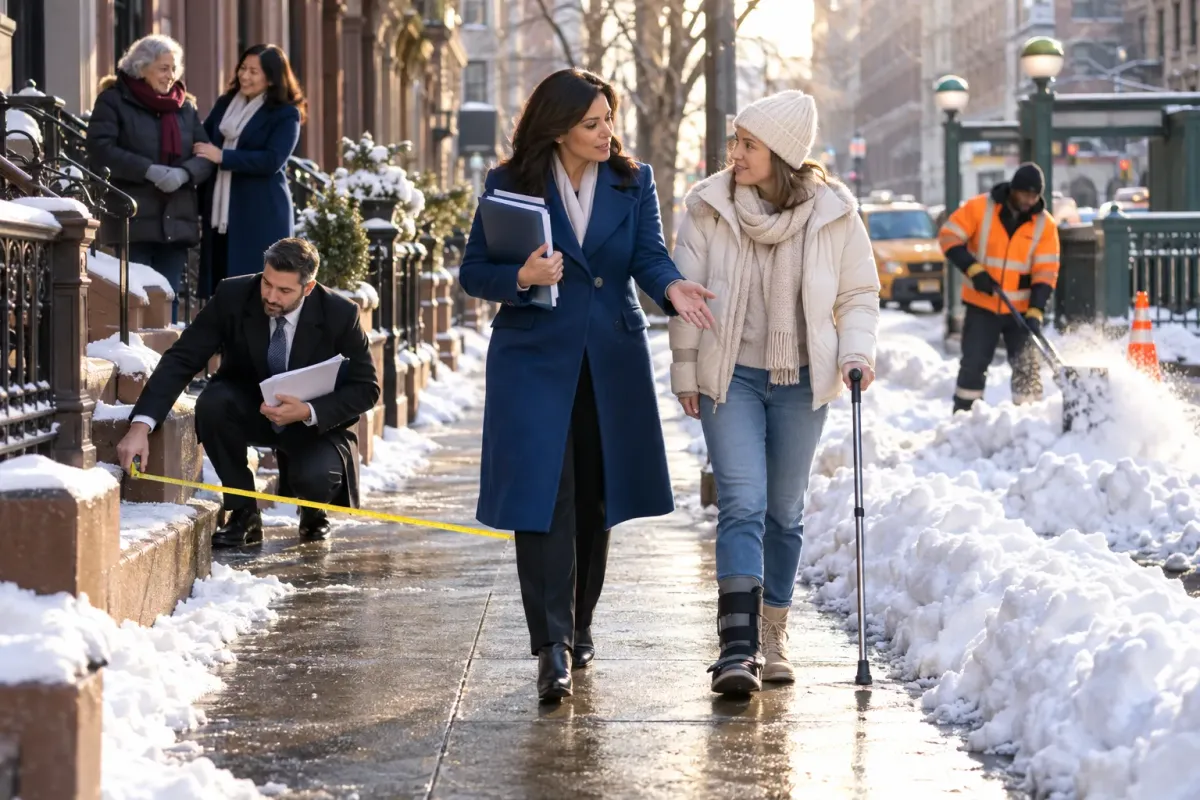
NYC snow rules set a deadline after snowfall ends, and the timing depends on when the snow stops. DSNY publishes the clearing schedule and sidewalk requirements. Property occupants should check current City guidance during a storm, since changing snowfall and refreezing slush can complicate safe clearing.
When You Must Shovel: Deadlines After Snowfall Ends (4 Inches or Less vs. More)
Under the City’s published schedule, snow that stops between 7 a.m. and 5 p.m. must generally be cleared within four hours. If it stops between 5 p.m. and 9 p.m., clear it by 11 p.m. If it stops between 9 p.m. and 7 a.m., clear it by 11 a.m. The four-hour period does not apply overnight in the same way as daytime snowfall.
Some guidance discusses snowfall of four inches or less separately from heavier accumulation. Do not treat that threshold as permission to leave a dangerous sidewalk uncleared. Follow DSNY’s current instructions for the storm and clear the required pedestrian route by the applicable deadline.
The 4-Foot Cleared Path Requirement for Pedestrians and Wheelchairs
Property occupants must clear a path at least four feet wide on the sidewalk, according to DSNY’s snow-removal rules. The path should allow pedestrians and wheelchair users to pass without stepping into traffic or pushing through deep snow. Clear enough width along the sidewalk, rather than creating a narrow trench that blocks mobility devices or strollers.
Clearing Fire Hydrants, Crosswalks, and Curb Cuts
Shovel snow away from fire hydrants and keep curb cuts and pedestrian access points open. Snow piled at a corner can block a wheelchair route, hide uneven pavement, or force a person into the street. Do not push cleared snow into a crosswalk, curb ramp, or another part of the sidewalk that people need to use.
Fines for Failing to Clear Snow: First, Second, and Repeat Violations
NYC fines for failing to clear snow and ice can range from about $100 to $350 or more, depending on the property and repeat violations, according to City snow-law guidance. The amount can vary by violation category. A fine is a City enforcement penalty; it does not decide whether an injured pedestrian can bring a separate injury claim.
- Check the snowfall end time and the applicable clearing deadline.
- Clear a four-foot sidewalk path and open pedestrian access points.
- Move snow away from hydrants, curb cuts, and crosswalks.
- Recheck the path when slush refreezes or new snow accumulates.
Landlord vs. Tenant: Who Shovels in a Rental Building?
A lease can assign snow-clearing work to a tenant, but that does not automatically settle who bears legal responsibility if someone falls. NYC Administrative Code §16-123 names the owner, lessee, tenant, or occupant of property next to a sidewalk. The facts matter: who controlled the area, what the lease says, and who was responsible for maintaining it.
Can a Lease Make the Tenant Responsible for Snow Removal?
A lease may require a tenant to shovel a specific area, such as a walkway used only by that tenant. That clause can establish a contractual duty between tenant and landlord. It does not, by itself, guarantee that the tenant becomes the only person legally responsible to an injured pedestrian.
Read the full lease and any building rules. Look for the area covered, when clearing must happen, whether the tenant must spread salt, and whether the landlord retains maintenance or repair duties. If the agreement is unclear, do not assume that a casual instruction from a superintendent changed the written terms.
How Lease Clauses Shift the Shoveling Work but Not Always the Legal Liability
A written agreement can show who was expected to shovel, but a court may also examine who owned, occupied, and controlled the location. The landlord’s role may remain relevant if the landlord kept control of a shared entrance, hired a snow-removal service, or failed to address a known hazard. The tenant’s role may matter if the tenant had a clear duty and control over the area where the fall occurred.
Keep a copy of the lease, notices from management, and messages about snow removal. Record who performed the work and when. These details help distinguish a written assignment from the practical control of the sidewalk or walkway.
Co-op, Condo, and Two-Family Home Scenarios
In a co-op or condominium, the board or managing agent may arrange maintenance for shared entrances, paths, and other common areas. The governing documents and actual control help identify who handled the snow-removal task. A resident who owns or rents an individual unit should not assume that the unit’s status alone answers who maintained the shared sidewalk.
In a two-family home, an owner who lives in one unit and rents the other still needs to examine the property arrangement and any written agreement. For example, a lease may assign a tenant a private walkway while the owner retains control of the front sidewalk. Identify the precise area and preserve the documents describing its upkeep.
Slipped on Uncleared Snow or Ice? Your Step-by-Step Action Plan
After a winter fall, get medical care first and document the scene as soon as you safely can. Slush can refreeze, footprints can disappear, and building staff may clear the spot before anyone records its condition. Silberstein & Miklos, P.C. handles New York slip-and-fall cases, and preserving early details can help establish where and when the hazard existed.
What to Do in the First Hour: Medical Care, Photos, and Witness Information
Ask for medical help if you are injured. Describe your symptoms accurately to the provider, even if pain worsens later. Do not delay care to gather evidence, and do not put yourself at risk to photograph an icy area.
- Photograph or video the exact spot, nearby snow and ice, lighting, entrances, and the surrounding sidewalk, if it is safe.
- Note the time, address, weather, and what you observed about the surface, including slush or refrozen patches.
- Ask witnesses for their names and contact information. Record what they saw in their own words.
- Keep the clothing and footwear you wore, and save medical records and receipts.
Evidence to Preserve This Week: Documentation Checklist and Reporting to 311
Write down your recollection while it is fresh, then keep copies of any incident report, medical paperwork, and messages with a landlord or building manager. Ask nearby businesses or the building promptly whether relevant video exists, since recordings may not remain available. A 311 report can document a complaint about a sidewalk condition, but do not assume that reporting it preserves every legal claim or meets a separate notice requirement.
NYC’s 311 system accepts reports about snow and ice conditions. Include the exact location and describe the obstruction or hazard clearly. Save the confirmation or reference number, and keep your own photographs and notes. Do not post original evidence only on social media; retain unedited copies.
The 3-Day Prior Written Notice Rule and How It Affects Your Claim Against the City
There is no general three-day rule requiring an injured person to notify the City after a sidewalk fall. For certain claims involving a City street or sidewalk defect, NYC Administrative Code §7-201(c)(2) generally requires the City to have received prior written notice of the defect before the injury, subject to limited exceptions. A 311 complaint does not automatically prove that the legal notice requirement was met. The location, type of condition, and available City records need prompt review.
A claim against New York City generally requires a notice of claim (a formal written statement of the claim) within 90 days. The New York General Municipal Law sets that deadline. A lawsuit generally must follow within one year and 90 days, subject to legal exceptions. Deadlines and rules differ for claims against private parties, so do not wait to identify who may be responsible.
When Property Owners Pay: Negligence Claims for Sidewalk Fall Injuries
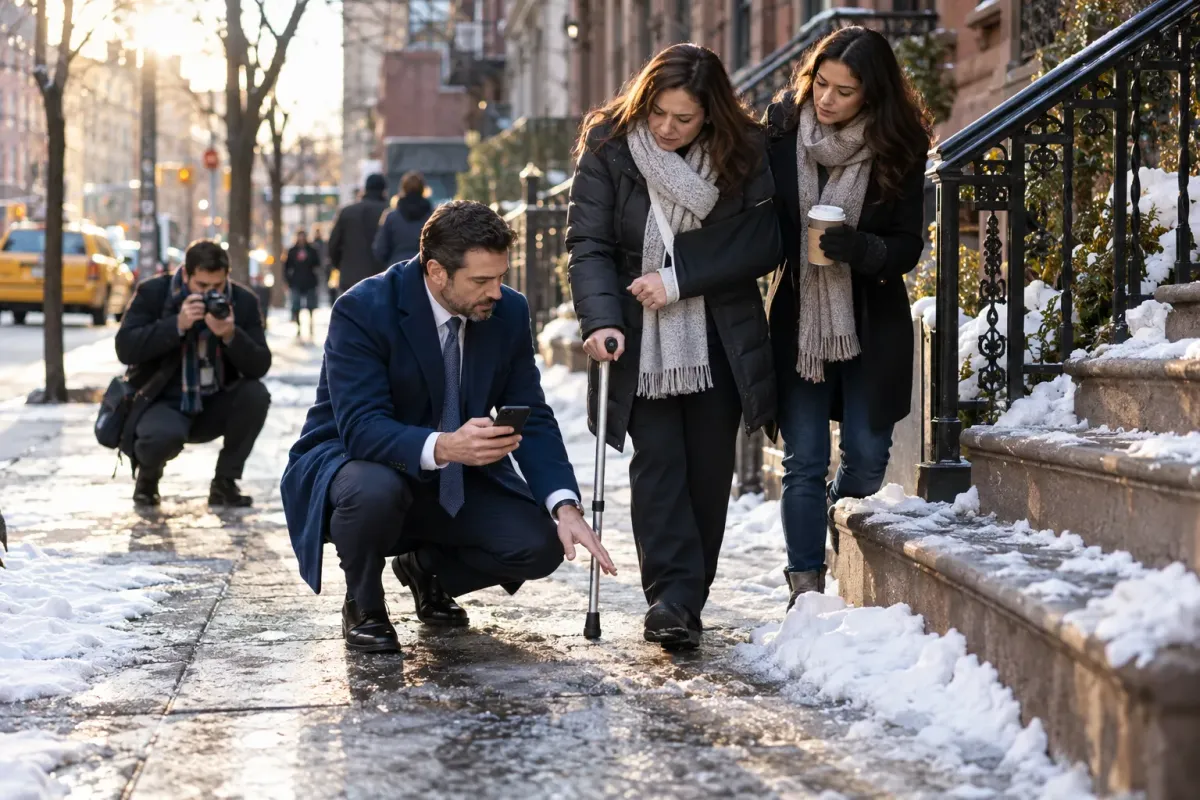
An uncleared sidewalk does not automatically make its owner liable for every fall. An injured pedestrian generally must show that a responsible party failed to use reasonable care, had the required notice of the dangerous condition, and caused an injury. The exact location, who controlled it, and how long the snow or ice was present all matter. These questions determine whether a claim may involve a property owner, landlord, building board, or the City.
Proving Negligence: What You Must Show After a Snow or Ice Fall
Negligence means failing to take reasonable care. In a snow or ice case, evidence must connect the hazard to the fall and the resulting harm. The condition could be packed snow, a slushy patch that refroze, or ice hidden beneath fresh snow. Records of medical treatment, photographs, witness accounts, and maintenance logs can help establish what happened.
Notice is also a key issue. A claim may depend on whether the responsible party created the hazard, knew about it, or had enough time to discover and address it. A missed shoveling deadline can support a claim, but it does not alone prove every element. Preserve evidence showing the surface, weather, timing, and property control.
Who You Can Hold Accountable: Owners, Landlords, Boards, and the City
The party responsible depends on where the fall occurred and who owned, occupied, or controlled that area. A private sidewalk claim may involve the adjoining owner or another party responsible for maintenance. A landlord or co-op or condo board may also be relevant if it controlled the location or arranged its upkeep. A lease or maintenance agreement can help explain who handled the work, but it does not settle every question of legal responsibility.
Claims involving the City follow separate rules. New York City generally must receive a notice of claim within 90 days, and a lawsuit against the City generally must begin within one year and 90 days, subject to exceptions. Most injury lawsuits against private parties have a three-year deadline under CPLR 214, though exceptions can apply. Do not assume one deadline covers every possible defendant.
How a Free Consultation With Silberstein & Miklos Protects Your Claim
At Silberstein & Miklos, P.C., we examine the fall location, available photographs, maintenance records, and the parties who controlled the area. That review helps identify evidence to preserve and deadlines that need attention. Do not give an insurer a recorded statement or sign a settlement before you understand what it covers. A quick payment can leave you responsible for later medical care and other losses.
Our AV-rated attorneys bring decades of trial experience to serious injury claims across New York City and Long Island. We represent clients in English and Spanish, and we handle the legal fight while you focus on care and recovery.
Frequently Asked Questions
Does a tenant or landlord have to shovel the sidewalk in NYC?
Either may be responsible. Under §16-123, the duty falls on the owner, lessee, tenant, or occupant of the property adjoining the sidewalk, and a lease or property arrangement can affect who must clear it. If you were injured, identify the exact location of the hazard and the property that controls that spot.
