


Blog

Uneven Ground Construction Injury Lawyer Nassau County: Know Your Rights

uneven ground construction injury lawyer Nassau
If you are hurt after tripping, slipping, or falling on uneven ground at a Nassau County construction site, get medical care, report the injury in writing, and preserve evidence. Workers’ compensation may cover medical care and part of your lost wages. A separate claim may also be possible if a property owner or contractor caused the hazard. An uneven ground construction injury lawyer Nassau workers consult can investigate who controlled the site and what made the surface unsafe.
Key Takeaways
- Uneven walkways, trenches, and debris piles at Nassau County construction sites are preventable hazards, and someone on the job usually had a legal duty to fix or warn about them.
- Workers’ compensation can pay for your medical treatment and a portion of your wages, but it does not compensate you for your full pain and suffering.
- Under New York Labor Law, property owners and general contractors can be held responsible for dangerous site conditions even when they did not directly cause the hazard.
- Photographs of the ground condition, witness names, and a written incident report can make or break your claim, so gather them as soon as your condition allows.
- Strict filing deadlines apply to both workers’ compensation and third-party claims, so contact an experienced attorney quickly to protect your right to maximum compensation.
At Silberstein & Miklos, P.C., our attorneys handle construction accident cases and assess how workers’ compensation and third-party claims may apply. The right steps early can help protect your health and preserve useful evidence.
Injured on Uneven Ground at a Nassau County Construction Site? Here’s What to Do Right Now
Seek medical attention, notify your employer in writing, and document the ground condition as soon as it is safe. Do not guess about fault or provide a recorded statement to an insurance adjuster before you understand your rights. If a family member is hospitalized, help preserve photos, names, and paperwork while they focus on care.
Get Medical Care First: Even If the Injury Seems Minor
Tell the medical provider that you fell or were injured at work, and describe where and how it happened. Some injuries become more noticeable later, and a medical record made soon after the incident can connect your symptoms to the fall. Follow the treatment instructions and keep visit summaries, prescriptions, and bills. Do not return to demanding physical tasks before a medical professional says it is safe.
Report the Injury to Your Employer in Writing
Notify your supervisor or employer promptly. Include the date, approximate time, exact worksite location, what you were doing, and the condition that caused your fall, such as loose fill, a rut, debris, or an uneven walkway. Keep a copy or proof of delivery. New York workers’ compensation generally requires written notice to the employer within 30 days, so do not rely on a verbal report alone.
Step-by-Step Evidence Checklist for Uneven Ground Injuries
Site conditions can change quickly when crews repair a walkway, move materials, or cover an excavation. If you can do so safely, ask someone to document the area before that happens. A family member or coworker can help while you receive care.
- Photograph the ground from several angles, including a wider view that shows nearby signs, equipment, and access routes.
- Record the worksite address, date, time, weather, lighting, and names of witnesses.
- Save work messages, incident reports, medical paperwork, and any photos or video you already have.
- Write down what you remember while the details remain clear, without guessing about facts you did not see.
What Not to Say to Insurance Adjusters
Do not speculate about how the fall happened, minimize your pain, or accept blame before the facts are reviewed. Avoid signing a broad medical authorization or accepting a quick settlement without understanding what it covers. A recorded statement can preserve your words while you are still injured and uncertain. Direct the adjuster to your attorney after arranging a free consultation.
Who Is Liable for Uneven Ground Injuries? Workers’ Comp vs. Third-Party Lawsuits
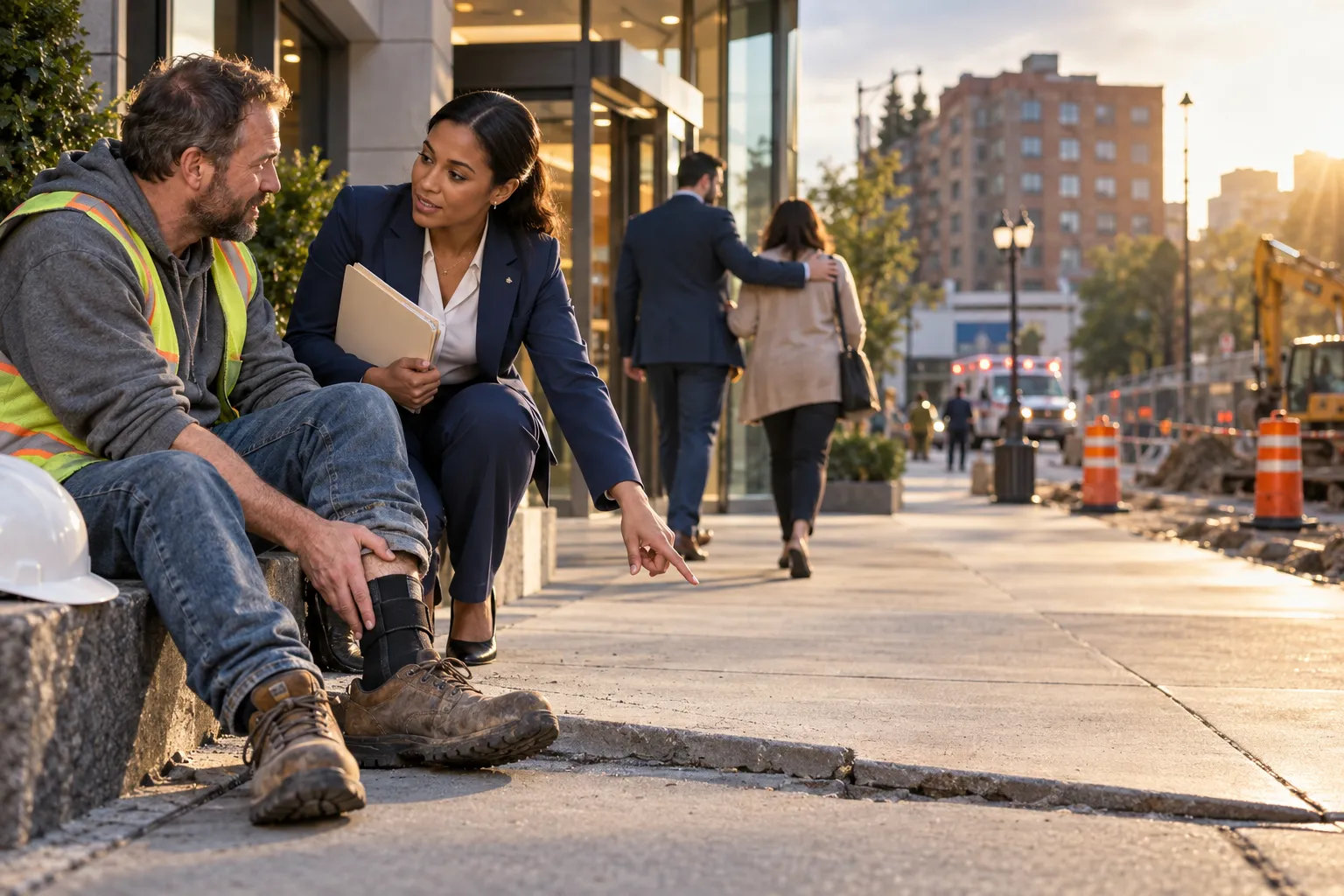
Workers’ compensation and a third-party lawsuit are different routes to recovery. Workers’ compensation is generally a no-fault system, meaning an eligible worker does not need to prove that the employer caused the injury. A separate claim may apply if another responsible party, such as a property owner or general contractor, created the dangerous condition or failed to address it. The facts of site control, work duties, and hazard management matter.
Workers’ Compensation: What It Covers and What It Doesn’t
Workers’ compensation can provide medical benefits and partial wage replacement for an eligible worker with a job-related injury. It does not generally pay damages for pain and suffering. Report the injury and follow claim procedures; missed paperwork or delayed notice can complicate benefits. Keep records of treatment, time away from work, and communications about the claim.
Can I Sue My Employer in New York?
Usually, workers’ compensation is an injured employee’s exclusive remedy against an employer for a workplace injury. That means an employee generally cannot sue the employer in a standard negligence lawsuit. Exceptions can be fact-specific, so do not assume either that a lawsuit is available or that workers’ compensation is your only possible recovery. An uneven ground construction injury lawyer Nassau workers contact can review the employer relationship and identify other potentially responsible parties.
Third-Party Claims Against Property Owners and General Contractors
A third-party claim is a lawsuit against someone other than your employer. Depending on the site contracts and evidence, a property owner, general contractor, subcontractor, or another company may have had responsibility for the area or the work that created the hazard. Relevant evidence may include inspection records, site safety plans, work assignments, photographs, and witness accounts. Responsibility is not automatic; the investigation must connect a party’s conduct or legal duty to the unsafe condition and injury.
Workers’ Compensation vs. Third-Party Lawsuit: Side-by-Side Comparison
| Issue | Workers’ compensation | Third-party lawsuit |
|---|---|---|
| Who may be responsible | Employer’s workers’ compensation coverage | A potentially responsible party other than the employer |
| What must be shown | Work-related injury and eligibility under the claim rules | Evidence supporting legal responsibility and a connection to the injury |
| Potential recovery | Medical benefits and partial wage replacement | Potential damages may include losses not covered by workers’ compensation |
| Pain and suffering | Not generally covered | May be sought where the law and evidence support the claim |
These routes can proceed at the same time, though workers’ compensation may have a lien or repayment interest in a third-party recovery. Do not settle a lawsuit without reviewing how that could affect your benefits. Silberstein & Miklos, P.C. offers a Free consultation and Expertise in construction accident cases. For a Manhattan matter, see the Manhattan NYC Construction Injury Accident Lawyer page; the Manhattan NYC Construction Injury Accident Lawyer resource addresses a different location from Nassau County.
Gather your injury report, medical records, and site evidence, then contact counsel before giving a recorded statement or signing a settlement. An uneven ground construction injury lawyer Nassau workers choose should examine both benefit eligibility and potential claims against other parties.
How New York Labor Law Protects You When Uneven Ground Causes Your Injury
New York law may give an injured construction worker a claim beyond workers’ compensation, depending on how the hazard arose and who controlled the worksite. Labor Law §§ 241(6), 240, and 200 address different duties and types of danger. The ground condition, your task, and the evidence all matter. An uneven ground construction injury lawyer Nassau workers consult can assess which laws fit the facts, rather than assuming every fall qualifies under the same rule.
Labor Law §241(6): The Key Statute for Uneven Ground Hazards
Labor Law §241(6) requires owners and general contractors to provide reasonable and adequate protection for workers at construction, excavation, and demolition sites. A claim typically must identify a specific, applicable Industrial Code rule and show that its violation contributed to the injury. New York’s Industrial Code includes safety rules for passageways and working areas, including provisions concerning tripping hazards and slippery conditions. Whether a rule applies depends on the location and work being performed, not simply the fact that the ground was uneven.
Labor Law §240: When Ground-Level Falls Still Qualify
Labor Law §240(1) addresses certain elevation-related risks involving devices such as ladders and scaffolds. A fall at ground level is not automatically covered because uneven ground caused it. The question is whether the injury resulted from a risk the statute covers, such as a worker falling from an elevated work surface or being struck by a falling object due to inadequate protection. The precise work setup and hazard require careful review.
How OSHA Violations Strengthen Your Claim
OSHA construction standards in 29 C.F.R. Part 1926 set federal workplace safety requirements. A documented violation can help show what safety precautions were required or whether a hazard was recognized. It does not automatically prove liability under New York law, and OSHA standards do not create a personal injury lawsuit by themselves. Preserve inspection records, safety logs, site photographs, and witness information so counsel can evaluate how the evidence fits the applicable legal duties.
Proving Negligence When Multiple Parties Are Involved
Uneven ground can result from excavation, poor grading, debris, drainage, or work by another crew. Investigators examine who created or controlled the condition, who had authority to correct it, what inspections occurred, and whether the hazard was reported. Labor Law §200 and common-law negligence may apply where an owner or contractor had the required control or notice. Contracts, daily logs, site plans, and maintenance records can help identify each party’s role.
What Your Uneven Ground Injury Claim Is Worth in Nassau County
No fixed amount applies to every construction injury claim. Potential value depends on the injury, treatment, time away from work, long-term limits, and proof of another party’s legal responsibility. Workers’ compensation and a civil lawsuit use different rules and may cover different losses. A settlement or verdict cannot be predicted from the type of accident alone. Keep records of your care, income, and daily limits so the losses can be assessed with evidence.
Recoverable Damages: Medical Bills, Lost Wages, and Pain and Suffering
A third-party lawsuit may seek compensation for reasonable medical expenses, lost earnings, reduced future earning ability, and pain and suffering when supported by the facts and law. Workers’ compensation generally covers authorized medical care and partial wage replacement, but not pain and suffering. Benefits and a lawsuit can affect one another, including through a workers’ compensation lien. Review any proposed settlement with counsel before signing.
How Long Do I Have to File a Construction Injury Lawsuit in Nassau County?
CPLR 214 generally sets a three-year deadline to file many New York personal injury lawsuits. Exceptions can shorten or change that period, including claims involving public entities, which may require a notice of claim and faster action. Separately, New York Workers’ Compensation Law §18 generally requires written notice of a work injury to the employer within 30 days. These are distinct requirements; meeting one does not satisfy the other.
Nassau County Courts and Local Resources for Injured Workers
A civil injury lawsuit filed in Nassau County may be heard in New York State Supreme Court, Nassau County, in Mineola. Court filing rules and the proper venue depend on the parties and claim. Workers’ compensation matters follow a separate process through the New York State Workers’ Compensation Board. Confirm current procedures with the relevant court or agency, and do not assume a court filing also opens a compensation claim.
Why Filing Deadlines Make Fast Action Essential
Delay can put deadlines and useful evidence at risk. Site conditions may change, records may become harder to obtain, and witnesses’ memories can fade. Take these steps promptly:
- Keep copies of medical records, bills, wage information, and written injury notices.
- Record any lawsuit or workers’ compensation deadlines provided by an attorney or agency.
- Ask counsel to review whether a public entity, owner, or contractor is involved.
Silberstein & Miklos, P.C. offers a Free consultation and Expertise in construction accident cases. For Manhattan matters, the Manhattan NYC Construction Injury Accident Lawyer page addresses a different location; the Manhattan NYC Construction Injury Accident Lawyer resource is not a Nassau County court or filing guide. Contact counsel promptly to protect your rights and review the deadlines that apply.
Why Injured Nassau County Construction Workers Choose Silberstein & Miklos: Guidance for Your Next Steps

Choosing counsel means finding a team that can investigate site conditions, identify the parties with responsibility, and build a claim from reliable evidence. Silberstein & Miklos, P.C. has expertise in construction accident cases and holds AV Martindale-Hubbell recognition. Our attorneys serve injured workers across the New York metropolitan area, including Nassau County. We offer a Free consultation to discuss your situation and explain possible next steps.
Case Example: Holding a General Contractor Accountable for an Uneven Ground Hazard
Consider a worker who trips in an unmarked rut along a construction access route. A careful investigation would examine who created or controlled the route, whether the general contractor coordinated site safety, and whether anyone reported the condition before the fall. Relevant records could include site plans, inspection logs, work assignments, photographs, and witness accounts. This is an illustrative scenario, not a report of a specific firm case. The lesson is direct: responsibility depends on evidence connecting a party’s role and conduct to the hazard.
What If My Employer Retaliates Against Me for Filing a Claim?
New York law prohibits an employer from penalizing an employee for seeking workers’ compensation benefits. If your hours change, your job duties are reduced, or you face discipline after reporting an injury, keep messages, schedules, and written notices. Record dates and names, and avoid deleting communications. Retaliation concerns deserve prompt legal review, especially if you also have questions about who controlled the unsafe area. Do not let fear prevent you from documenting what happened and asking for advice.
How to Choose a Construction Injury Lawyer in Nassau County
Ask whether the attorney handles construction injury claims, understands New York Labor Law, and can investigate multiple contractors or property owners. Find out who will communicate with you, what evidence the firm will seek, and how workers’ compensation could affect a separate lawsuit. A clear explanation matters more than promises about a particular outcome. Silberstein & Miklos, P.C. also represents clients in Manhattan; the Manhattan NYC Construction Injury Accident Lawyer resource concerns that location, not Nassau County. The Manhattan NYC Construction Injury Accident Lawyer page is not a substitute for advice about a Nassau County claim.
Frequently Asked Questions
Can I sue my employer after a construction accident in New York?
Usually no. Workers’ compensation is generally the exclusive remedy against your employer for a workplace injury, so a standard negligence lawsuit against the employer is typically barred. Exceptions are fact-specific. A third-party claim against other responsible parties remains a separate and powerful option. Call Silberstein & Miklos, P.C. for a free consultation before you sign or say anything.
