


Blog

Workers’ Comp vs Personal Injury for Construction Workers in NY: Which Claim Fits Your Injury?

workers comp vs personal injury construction NY
Yes. A New York construction worker can generally receive workers’ compensation benefits and pursue a separate personal injury lawsuit against a responsible third party. Workers’ comp covers eligible benefits without proof of fault; a lawsuit seeks damages from a legally responsible party. Which routes are available depends on who caused the hazard, which losses need compensation, and which deadlines apply.
Key Takeaways
- Construction workers in New York can often collect workers’ compensation benefits while also filing a separate personal injury lawsuit.
- Workers’ compensation pays eligible benefits regardless of fault, so you do not need to prove negligence to receive them.
- A personal injury lawsuit targets a third party whose conduct created the hazard, such as a general contractor, property owner, or equipment manufacturer.
- Your available options depend on who caused the danger, which losses need full compensation, and which filing deadlines apply to each claim.
- New York’s Labor Law 240 gives injured construction workers added protection when falls and elevation hazards cause serious harm.
Silberstein & Miklos, P.C. handles construction injury cases as part of its Personal Injury Legal Services. Our AV-rated practice applies decades of trial experience to identify available claims and protect an injured worker’s options. A supervisor’s statement that workers’ comp is the only path does not settle whether a separate claim exists.
Workers’ compensation and a third-party personal injury lawsuit serve different purposes, so pursuing both does not automatically cancel either claim. Workers’ comp generally does not require proof that someone caused the injury. A lawsuit requires evidence that a party other than the employer bears legal responsibility. The site, injury, and parties involved determine whether both routes are available.
How we evaluated both claim paths (our side-by-side criteria)
Compare the claims by asking four questions: Is fault required? What losses can the claim pay? Which deadlines apply? Who can be held responsible? Workers’ comp can provide medical care and partial wage replacement without proving fault. A lawsuit can seek damages such as pain and suffering when law and evidence support them. Workers’ compensation law and the New York Civil Practice Law and Rules set different requirements and deadlines. Review the employer’s role separately from those of owners, contractors, and other potentially responsible parties.
The one-two punch: why comp and a Labor Law claim work together, not against each other
Workers’ comp can address treatment and some lost income while a separate claim seeks damages unavailable through comp. New York Labor Law §§ 240(1) and 241(6) can impose duties on owners and contractors in qualifying construction work. Section 240(1) addresses certain gravity-related hazards; § 241(6) concerns compliance with specific Industrial Code safety rules. Each claim has its own legal test. Benefits do not prove a third party’s liability or guarantee a lawsuit’s outcome.
Workers’ Compensation for Construction Injuries: What It Pays and Where It Stops
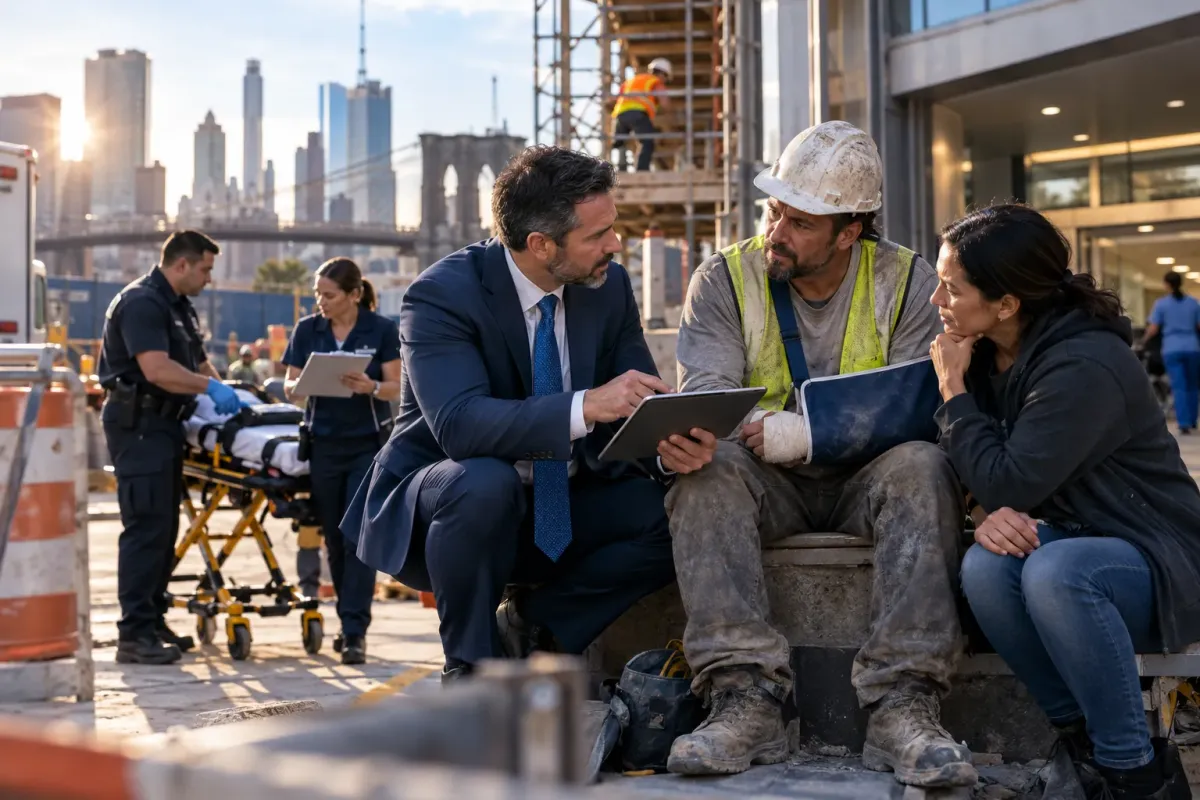
New York workers’ compensation is a no-fault insurance system for covered workplace injuries. It can provide medical treatment and wage benefits without requiring proof that the employer acted carelessly, but it does not cover every loss. The New York Workers’ Compensation Law, including § 11, generally limits an employee’s ability to sue the employer for a covered workplace injury. That restriction does not automatically bar a claim against a separate responsible party.
New York’s no-fault system and the exclusive remedy rule (why you cannot sue your employer)
“No-fault” means a worker generally does not need to show employer negligence to seek workers’ compensation. Under the exclusive remedy rule, workers’ compensation is generally the employee’s remedy against the employer for a covered injury. New York Workers’ Compensation Law § 11 sets out this restriction, subject to limited exceptions. Not every company on a construction site is the employer, so identify each company’s role before ruling out a separate claim.
What comp covers: medical care, wage replacement, schedule loss of use
Workers’ comp can cover authorized medical care related to the work injury and partial wage replacement, subject to legal calculations and limits. New York wage benefits are generally based on a portion of the worker’s average weekly wage, not necessarily full take-home pay. A schedule loss of use award may apply when a covered injury causes permanent loss of use in a body part listed by law. Medical evidence and the claim’s facts affect eligibility and amount.
What comp never pays: pain and suffering, full wages, future earning capacity
Workers’ compensation does not pay damages for pain and suffering. Wage replacement may fall short of full earnings, and comp does not award a separate amount for lost future earning capacity in the way a successful injury lawsuit may seek economic damages. Statutory limits apply to benefits such as schedule loss of use awards. These limits can leave losses uncompensated, so workers comp vs personal injury construction NY requires review of both benefit eligibility and possible third-party responsibility.
Workers’ Compensation Benefits: What They Address
Potential benefits
- Medical care for a covered work injury, subject to claim rules.
- Partial wage replacement without proving fault.
- Possible schedule loss of use benefits for qualifying permanent impairment.
Limits to understand
- No payment for pain and suffering.
- Wage benefits may be less than full earnings and remain subject to statutory limits.
- Benefits do not resolve whether a separate party bears responsibility.
Personal Injury Claims Against Third Parties: Who You Can Sue Besides Your Employer
A construction injury claim can involve parties beyond your employer, including a property owner, general contractor, subcontractor, or equipment maker. Identify who controlled the work, created or failed to correct the hazard, or supplied the equipment. In our review of construction cases, the job-site contract structure and the worker’s actual tasks help clarify which parties deserve investigation. A workers’ compensation claim does not answer whether a third party can be sued.
Identifying every defendant on the job site: a walkthrough of the construction hierarchy (owner, general contractor, subcontractors, equipment makers)
Start with the site address and property owner. Identify the general contractor and subcontractors responsible for the work area, task, or equipment. Compare that information with the worker’s employer, site safety plan, incident reports, contracts, and witness accounts. A company’s name on a hard hat or sign does not establish its legal role.
Trace the hazard: who supplied and maintained the ladder, scaffold, hoist, or other equipment; who directed the work; and who knew about the unsafe condition? A manufacturer or supplier can face a product liability claim if a defective product caused the injury. Evidence must support each party’s legal responsibility. This defendant review matters because an owner or contractor may be a separate potential defendant.
New York Labor Law § 240(1): the Scaffold Law’s absolute liability for gravity-related falls
New York Labor Law § 240(1), often called the Scaffold Law, protects workers performing covered construction, repair, or alteration work from certain elevation-related hazards. It requires owners and contractors to provide appropriate safety devices, such as scaffolds, ladders, hoists, or harnesses. A claim can apply when a fall or falling object causes injury because required protection was missing or inadequate.
The law imposes absolute liability when a statutory violation is a proximate cause of the injury, meaning it helped cause the harm. A worker’s carelessness does not automatically defeat a claim, though a defense may argue the worker’s conduct was the sole cause. Whether proper safety equipment was available and adequate matters.
Labor Law § 241(6) and § 200: safety rules for the rest of the site
Labor Law § 241(6) requires owners and contractors to provide reasonable and adequate protection in covered construction and excavation work. A claim must identify a specific, applicable provision of the New York Industrial Code and show that its violation contributed to the injury. Depending on the facts and cited rule, it can address hazards beyond elevation risks, including unsafe work areas or equipment.
Labor Law § 200 and common-law negligence address unsafe conditions and work practices. A claim often turns on whether the defendant created the hazard, had notice of it, or controlled the means and methods of the work. A site inspection, photographs, safety records, and testimony can help establish which legal test applies.
The homeowner exemption for one- and two-family dwellings
Owners of one- or two-family homes can qualify for an exemption from liability under Labor Law §§ 240(1) and 241(6) when they did not direct or control the work. The exemption is not automatic just because the property is a residence; the owner’s role matters. A contractor’s presence alone does not determine whether the exemption applies.
Do not rule out an owner or contractor before checking the site records and the work arrangement. Silberstein & Miklos, P.C. provides Personal Injury Legal Services for construction injury cases. Our team examines potential defendants and applicable Labor Law protections rather than treating a comp claim as the end of the analysis.
Side-by-Side Comparison: Damages, Fault, Deadlines, and Defendants
Workers’ compensation and a third-party lawsuit differ in who pays, what the worker must prove, and which losses may be recovered. Workers’ comp generally pays eligible benefits without proof of fault. A lawsuit requires evidence of a defendant’s legal responsibility and can seek damages beyond comp benefits, including pain and suffering. Eligibility, damages, and deadlines depend on the facts and parties involved.
Comparison table: eligibility, fault rules, damages, filing deadlines, and who pays in each claim
| Issue | Workers’ compensation | Third-party personal injury lawsuit |
|---|---|---|
| Who may be responsible | Workers’ compensation coverage for an eligible work injury | A legally responsible party other than the employer, such as an owner, contractor, or equipment maker |
| Fault required | Generally, no proof of negligence is required | Evidence must establish liability under the applicable law |
| Potential recovery | Medical care and partial wage replacement; statutory benefits may include a schedule loss of use award | Potential economic damages, such as lost earnings, and non-economic damages, such as pain and suffering |
| Typical deadline to examine | Workers’ compensation notice and claim deadlines apply | Generally three years for an injury action under CPLR § 214(5); shorter notice rules can apply to public entities |
| Payer | The employer’s workers’ compensation insurer or self-insured employer | The responsible defendant or applicable liability insurer, if liability and damages are established |
Comparative negligence: how sharing blame affects a lawsuit but not your comp benefits
New York follows comparative negligence for many personal injury claims. If a worker shares fault, a court can reduce damages in proportion to that share. That rule does not generally bar workers’ compensation benefits merely because the worker contributed to the accident. Labor Law § 240(1) has a distinct rule: when a statutory violation was a proximate cause, ordinary comparative negligence does not reduce recovery, though a defendant may argue the worker was the sole proximate cause.
Deadlines that run together: the three-year statute of limitations and the 90-day notice-of-claim trap on public job sites
CPLR § 214(5) generally sets a three-year deadline to file a New York personal injury lawsuit. A claim involving a city, town, county, or other public entity can require a notice of claim within 90 days under General Municipal Law § 50-e. This formal document alerts the public entity to the claim. It is separate from the lawsuit deadline, and missing it can seriously affect the right to sue.
Check lawsuit deadlines without waiting for a workers’ compensation decision. Silberstein & Miklos, P.C.’s Personal Injury Legal Services include reviewing potential defendants, deadlines, and evidence. Contact the firm for a free consultation before a notice period or filing deadline passes.
How to Protect Both Claims: Your First 72-Hour Checklist

In the first three days after a construction injury, focus on medical care, a clear report, and preserving evidence. These steps document what happened while details remain fresh and help identify whether a third party played a role. If you are helping an injured family member, keep paperwork and record who you speak with. Silberstein & Miklos, P.C. provides Personal Injury Legal Services for construction accident cases, including review of potential claims alongside workers’ compensation.
Step-by-step actions in the first 72 hours (report, medical records, photos, witness names)
Get medical care first. Tell the provider how and where the injury happened, describe each symptom, and follow the recommended care plan. Request visit summaries, test results, and work restrictions. Prompt, accurate records connect the injury to the event and document its effects.
Report the incident in writing to your employer or site supervisor, and keep a copy. Record the date, time, exact location, task, equipment, and witness names. If safe, photograph the area, safety devices, ladder or scaffold, warning signs, and visible injuries. Do not alter equipment or enter a dangerous area to take pictures.
Case example: a scaffold fall with a rented ladder shows both claims working together
Illustrative scenario, not an actual client matter: A worker falls from a scaffold while a rented ladder is being used nearby. The worker reports the injury and seeks medical care, preserving eligibility for workers’ compensation benefits. Photos, rental records, site logs, and witness accounts could help investigators assess whether a contractor, property owner, or equipment supplier bears legal responsibility. The facts determine whether a separate claim exists; the equipment’s presence alone does not establish fault.
Do not jeopardize your lawsuit while your comp claim is pending: what to avoid signing and saying
Do not sign an insurer’s release, settlement, recorded statement, or broad medical-record authorization before a lawyer reviews it. A release can end claims against the parties it covers, including claims involving future treatment or lost income. Give accurate information to medical providers and required workers’ compensation contacts. Do not guess about the cause, minimize symptoms, or post injury details and site photographs on social media.
Keep copies of every form and note the date and recipient. If a public entity or authority owns the site, seek legal advice immediately about the separate 90-day notice-of-claim deadline under General Municipal Law § 50-e. Call Silberstein & Miklos, P.C. for a free consultation before signing documents or waiting for an insurer’s decision. The firm’s Personal Injury Legal Services include reviewing construction injury evidence and protecting available legal options.
Frequently Asked Questions
Can I get workers' comp and sue someone in NY after a construction injury?
Yes. A New York construction worker can generally receive workers’ compensation benefits and file a separate personal injury lawsuit against a responsible third party. Which claims apply depends on who caused the hazard, which losses need compensation, and which deadlines apply. Call Silberstein & Miklos, P.C. for a free consultation to protect every option.
What is workers' comp in NY?
Workers’ compensation in New York is a no-fault insurance system that pays medical care and partial wage replacement for covered workplace injuries. You do not need to prove your employer was careless. It does not pay for pain and suffering and wage benefits may be less than your full earnings.
Why can't I sue my employer for a construction accident?
New York Workers’ Compensation Law § 11 sets out the exclusive remedy rule, which generally makes workers’ comp your only remedy against your employer for a covered injury. That restriction does not bar a claim against other responsible parties. Property owners, general contractors, and subcontractors are not your employer, so identify each company’s role.
What is the difference between workers' comp and a personal injury lawsuit?
Workers’ comp pays medical care and partial wage replacement without proving fault. A personal injury lawsuit requires evidence that someone other than your employer bears legal responsibility, and it can seek damages unavailable through comp, such as pain and suffering. Deadlines also differ between the two claims.
Who can I sue besides my employer after a New York construction accident?
You may have a claim against a property owner, general contractor, subcontractor, or equipment maker. New York Labor Law §§ 240(1) and 241(6) can impose duties on owners and contractors in qualifying construction work. Identify who controlled the work, created the hazard, or supplied the equipment.
Do I have to quit my job to get a workers' comp settlement?
No. Quitting your job is not required to receive or settle a workers’ compensation claim in New York. Eligibility and benefit amounts depend on your injury and medical evidence, not your employment status. Do not accept a supervisor’s statement that comp is your only path before having your options reviewed.
What should I do if my supervisor says workers' comp is my only option?
Do not take that statement as final. A supervisor cannot decide whether a separate claim exists. Job-site relationships, the cause of the hazard, and filing deadlines all determine your rights. Contact Silberstein & Miklos, P.C. before signing anything so a full review protects your claim.
